
Filter Your Stage
Filter By Keyword
Filter By Prime Area
Filter By Specific Area
-

Park Play
Swing, skip, slide! Parks and playgrounds help your child’s development in so many ways, and sharing the experience alongside your child is a perfect opportunity to build their confidence and vocabulary! Benefits: Top tips:
-

Exploring Books
Little readers, big adventures! Explore books with your baby or child every day if you can; this is a special time where you can have have a shared moment of interest. Babies love hearing you read even if they don’t understand the story! Children often enjoy hearing the same book over and over again; this…
-

Time to Rhyme
Research shows that children who know 8 nursery rhymes by heart at age 4, are likely to be more confident at spelling and reading by age 8! Singing and listening to nursery rhymes are both really important to help your child’s development. Nursery rhymes were invented to help people remember chunks of language and that’s exactly what…
-
Home-Start Colchester, Jaywick and Clacton
Home-Start is a family support service. About Home-Start Colchester, Jaywick and Clacton Starting in the home, the Home-Start approach is as individual as the people we’re helping. No judgement, it is just compassionate, confidential help and expert support. Across the North East Essex quadrant there are two independent Home-Start charities both rooted into the local communities…
-

Home-Start Harwich
Home-Start is a family support service. About Home-Start Harwich Starting in the home, the Home-Start approach is as individual as the people we’re helping. No judgement, it is just compassionate, confidential help and expert support. Across the North-East Essex quadrant there are two independent Home-Start charities both rooted into the local communities they service. Home-Start Harwich…
-

Home-Start Essex
Home-Start is a family support service. About Home-Start Essex Home-Start Essex aims to give children the best possible start in life by supporting parents and caregivers to feel less isolated, to build their confidence in themselves and their parenting and to find ways to manage the challenges they face. We build trusting, helpful relationships with…
-

Essex ActivAte Holiday Programme
Fun filled holidays! Funded by Department for Education and Essex County Council, Essex ActivAte is the name for the Holiday Activity and Food programme (HAF) run by Active Essex across Essex and Thurrock. The programme offers engaging holiday clubs and free activities run by local club providers, and free spaces are offered to children and…
-

Read and Count With Me By the Sea
We planned something exciting during the Essex Year of Numbers! In Summer 2024, we worked in partnership with Essex Libraries, Active Essex, Essex Child and Family Wellbeing Service and Home-Start Harwich to bring you ‘Read and Count With Me By the Sea’ borrow bags. The bags included sea themed story books and a beach themed…
-

Childcare Funding
Childcare funding and support available in Essex Funded Early Education Entitlement (FEEE) FEEE is for eligible working families from the term after a child turns 9-months-old until statutory school age. The number of FEEE hours that working families are eligible for depends on the age of their child and their circumstances. Currently, eligible working parents/carers…
-

Dummies
Everything you need to know! Whether you call them dummies, soothers or pacifiers, there is lots of information available about how they can negatively impact a child’s development. We want to share some of this information to help you make an informed decision about how your child uses a dummy, and how to avoid later…
-

Puzzle Play
Piece by piece! There’s lots of ways you can use this classic toy – in particular an inset puzzle – to build your child’ speech, language and communication skills! Puzzles also help to develop: Top tips:
-

Supporting Your Child’s Speech and Language Development
Your very own talking toolkit! It makes a huge difference when family members support their child’s speech, language and communication at home. In this recorded webinar we share how speech, language and communication develops, and how adults can support this development during everyday experiences. We share our Talk, Listen, Cuddle Top Ten Talking Tips – these…
-

Water Play
The wonders of water! Water is fascinating to children and is appropriate to all ages. Many children like playing with water whether it’s jumping in puddles, splashing in the sink when washing their hands, playing at bath time or having fun in a paddling pool! Water play can be a sociable occasion and exciting, or…
-

Makaton
Say it, sign it! Makaton is a language programme made up of symbols and signs that accompany speech, and is shared with young children to support early speech and language development. Research shows us that using gestures and signs when we are talking and singing helps children with their understanding and to learn new words.…
-
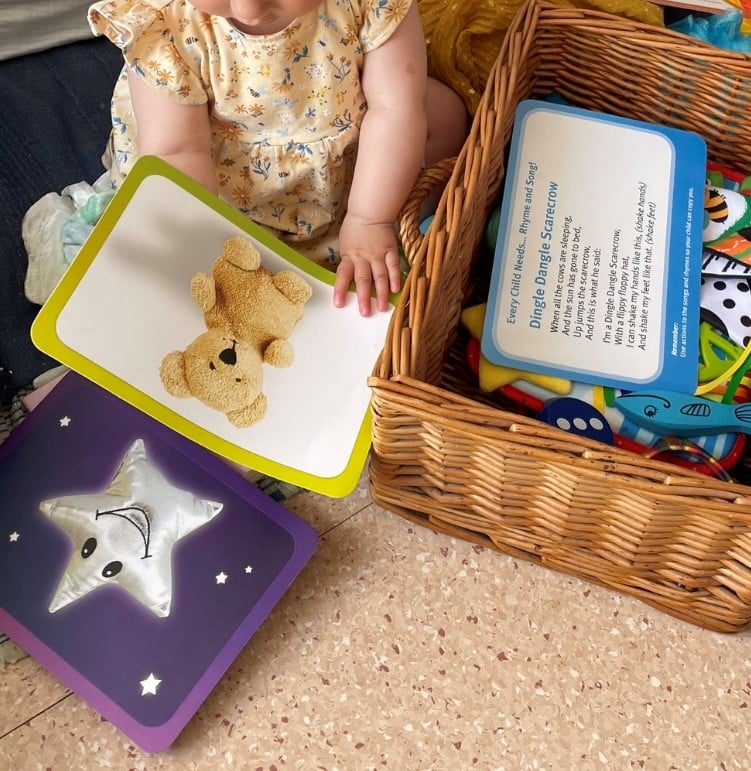
Rhyme Time Sacks
Research shows that children who know 8 nursery rhymes by heart at age 4, are likely to be more confident at spelling and reading by age 8! Singing nursery rhymes is a is a lovely activity to help bond with your baby, and later on, a great way of building your child’s vocabulary. A ‘rhyme…